
Pokopia Guides
33 guides covering every system in Pokopia, from your first habitat to the deep-water dives.
You play as a Ditto, and the moves you use to reshape the island are learned by befriending Pokémon rather than found as items. Every move draws on a shared PP pool, so nothing can be spammed indefinitely.
Building is not limited to habitats. Anything with four walls and a door can house a Pokémon, so a structure you design yourself works as well as a kit.
Gimmighoul and Gholdengo have the Collect specialty, which is what makes leftover Rainbow and Silver Feathers useful once both bells are made.
Crafting is the main route to most items, and the gate is the recipe rather than the materials. Recipes come from the PC Shop, which stocks more as an area gains Environment Levels, from story progress, and at random from water ripples that refresh daily.
Diving arrived in the Version 2.0 update and unlocks for everyone after you help Manaphy at Bleak Beach. Shoulder buttons move you up and down, and holding B swims.
Rebuilding runs on power. Many items need electricity, including ones habitats depend on, and the mechanic is introduced at Bleak Beach when the town needs lighting.
Emotes come from Human Records, as gifts from Pokémon you have befriended, and some only from inviting particular species over from another player island, locally, online or through a Cloud Island.
Every area carries its own Environment Level, from 1 to 10, and it is the clearest measure of how far a rebuild has come. Each level unlocks Poké Life PC challenges and widens what the shop stocks, with a gift of items at Level 5 and recipes at Level 10.
The Expansion Pass covers three packs released over time and costs £29.99 / €34.99 / $34.99, with all three included in the single purchase.
Each area has its own plants, berries and hedges, and each comes in five colours and five berry types across the game as a whole.
Friendship is tracked separately from Comfy Level, though raising one tends to help the other. Completing a Pokémon request or handing over a gift moves the gauge.
Furniture is both decoration and currency for keeping Pokémon happy. Pieces flagged Relaxation or Decoration are the ones Pokémon request to raise their Comfy Level; the rest are utility or looks.
The loop is simple to describe: reshape the island, and the Pokémon come to you. Paths, bridges and buildings are all yours to place, and habitats are what draw wild Pokémon in.
Befriending Zorua grants Camouflage, which turns Ditto into any nearby object, and that unlocks Hide-and-Sneak. You are dropped away from the Pokémon Center and have three minutes to reach the PC unseen.
A notification tells you a photo opportunity is nearby; raise the camera and a frame hovers over the spot. Each is one entry in the Highlight Reel collection.
Kanto has no people left, and working out why is the job you share with Professor Tangrowth. The evidence is Human Records: letters, magazines and tablets that sparkle as you approach.
Important Requests are the spine of the story. Each one has you helping the Pokémon of an area, lifting its Environment Level and your Trainer Rank, and every area includes rebuilding its Pokémon Center.
A launch distribution ran globally from 5 March 2026 to 31 January 2027, giving a special Ditto Rug. The same rug becomes obtainable in-game later, so missing the window is not permanent.
Befriend Bulbasaur and rebuild the Pokémon Center and you can ask it to turn a rope. Jump its vines for as long as you can; the pace steps up every ten successful jumps, and past fifty it turns deliberately erratic.
Litter is the most quietly useful specialty in the game. Most specialties convert one material into another; Litter produces items from nothing.
After the story ends, a Magnemite waits under the departed rocket in the Withered Wastelands and teaches Magnet Rise. It costs PP per use and lets you fly freely, rotating as you go.
Finishing the Bleak Beach story lets you fully befriend Mosslax and build its habitat, the Gourmet’s Offering. From there its Eat specialty converts food into a buff.
Smearguru at Bleak Beach has the Paint specialty, which is how most items get recoloured. Paint comes from a Crush specialty Pokémon crushing berries or straight from the shop, and paint balloons let you throw it at things yourself.
The 5 August 2026 update shipped the Bubbly Basin Expansion Pass content and the Dive move, and extended the Build specialty to underwater houses.
The Pokédex runs to 300 Pokémon, and filling it means building the habitat each one wants. Milestones along the way pay out item recipes.
Every area starts with its Pokémon Center in ruins, and rebuilding it is one of Professor Tangrowth’s standing requests. The kit appears in the PC store once that area reaches Environment Level 3, and the build needs local resources plus Pokémon with Build, Bulldoze and Chop.
Buying the Expansion Pass before August 2027 sends a code by email for 30 Rare PokéMetal.
Visiting the PC each day earns a stamp on a weekly card, redeemed every Friday for Life Coins. Stamps come in four grades worth different amounts: Basic, Evolved, Legendary and Mew.
The odd building on the Withered Wastelands coast sets nine challenges, each asking for items you gather as you progress, and each completion earns a badge.
A Pokémon with the Trade specialty will set up shop anywhere you provide a powered cash register and a table, including the PokéMart and the Pokémon Center when no event is running.
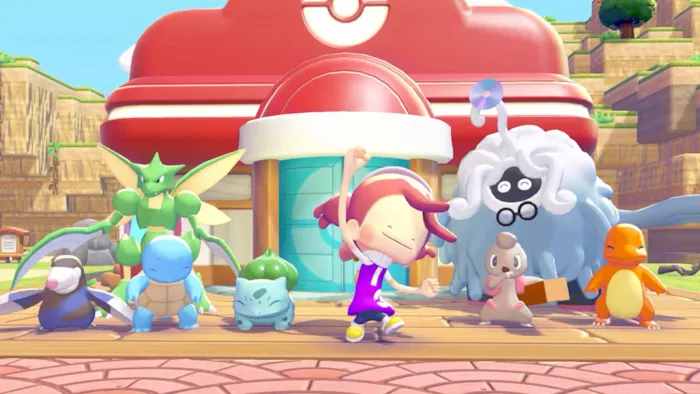
A few residents are unique to this game. Professor Tangrowth is your guide, living alone in the ruins of a place humans and Pokémon once shared, and it is Tangrowth who asks a Ditto for help rebuilding.
Vegetables restore PP when eaten and feed into meals, which power up moves and drive the Mosslax boosts, so growing them is worth the space.
Water does more than look good: it hydrates the ground around it for planting, and the game has five distinct kinds, each behaving differently.